

Table of Contents
ToggleWhen running paid campaigns, maintaining strong Website Security for Google Ads should be your top priority. A single security breach or malware flag can cause Google to immediately halt your campaigns, costing your business valuable traffic and ad budget.
How Sally turned her website into a fortress - and why every business running ads must do the same.
The first time Sally built her online office, it was elegant – soft colors, comforting words, and an invitation to trust.
The second time, it was indestructible.
Because by then, she’d learned something every advertiser eventually faces:
A beautiful website attracts clicks.
A secure website keeps your business alive.
🏚️ The Breach That Changed Everything
Sally’s will-writing business had grown quickly, thanks to steady Google Ads campaigns.
Then, one morning, it all vanished.
Her site had been hacked – injected with malicious redirects and scripts that sent users to strange pages.
Google suspended her Ads account instantly, citing “Malicious Content” and “Circumventing Systems”.
In one night, her most reliable client channel disappeared.
She cleaned up, rebuilt, and recovered.
But this time, she made a promise to herself:
“If I ever build again, it will be a fortress.”
🧱 The Fortress Mindset
When Sally’s campaigns got suspended, she realized that maintaining strong Website Security for Google Ads meant changing her entire approach.
Instead of hiring just a web designer, she partnered with a security strategist to create “The Digital Fortress Framework.”
Built on four simple yet powerful principles, it protects ad accounts from unexpected bans:
It had four principles – simple but powerful:
- Protect the perimeter – block threats before they touch your site.
- Strengthen the core – secure the CMS, plugins, and database.
- Watch the walls – monitor activity in real-time.
- Keep the keys safe – restrict who can enter, and how.
⚙️ Building the Fortress
1. Choose hosting that protects you, not just hosts you.
Most small businesses choose hosting based on price. Sally learned to choose based on protection.
She migrated her new website to a host with:
- Built-in Web Application Firewall (WAF)
- Spam and bot filtering
- Daily malware scanning
- Automatic backups and SSL renewal
🧰 Examples:
- SiteGround (includes AI anti-bot & server-level firewall)
- WP Engine (real-time threat blocking + automatic patching)
- Cloudways (integrates Cloudflare Enterprise WAF)
“I used to think hosting was just storage,” Sally said.
“Now I know it’s the foundation of my digital house.”
2. Add a dedicated Web Application Firewall (WAF)
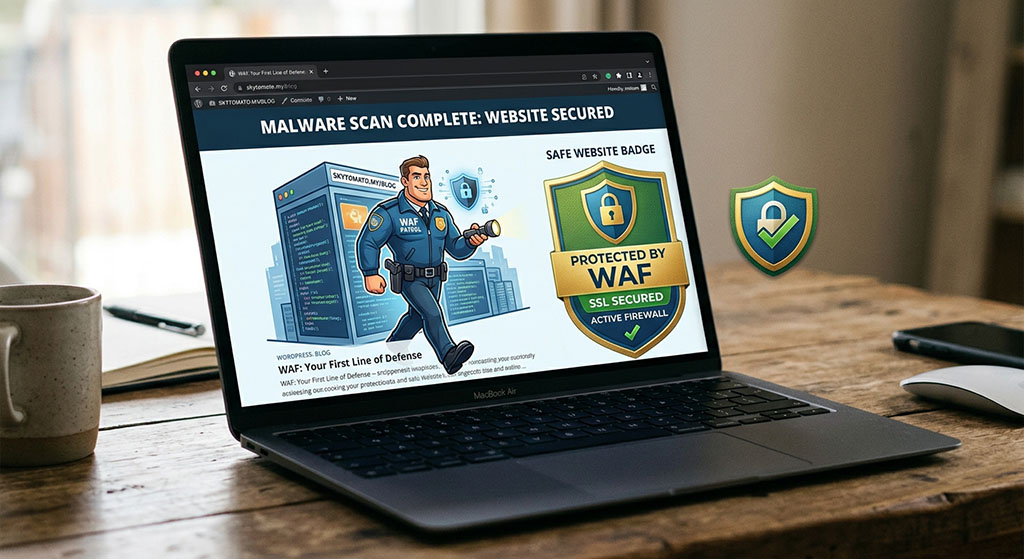
Even with good hosting, Sally added an extra layer: a WAF that actively filters malicious traffic before it reaches her site.
Two she considered — and still uses across all her projects:
- 🧩 Sucuri: Cloud-based WAF that blocks DDoS attacks, SQL injections, and spam bots.
- 🛡️ Wordfence: Plugin-level WAF for WordPress with real-time firewall rules and login security.
Both also include malware scanning, IP blocking, and two-factor authentication (2FA) for admin logins.
Think of a WAF as your digital security guard – standing at your website’s front door, checking every visitor’s ID.
3. Secure your access points
Sally learned that most hacks don’t start from the outside – they start from within.
She:
- Removed all unused admin accounts.
- Set strong, unique passwords via a password manager.
- Enabled 2FA for every login.
- Limited admin logins by IP address (so only she and her developer could access).
- Installed reCAPTCHA on forms to stop bot submissions.
“The fewer doors you have,” her developer said, “the fewer locks you need to worry about.”
4. Keep your tools clean and current
Sally’s first hack had come from an outdated plugin.
Now, she keeps everything updated – weekly.
She also removed:
- Abandoned plugins and themes
- Demo content and test pages
- Old admin user accounts
She installed WP Activity Log to track changes, so she could see who did what, when.
Every suspicious change now triggers an instant alert.
5. Scan, back up, repeat.
Sally’s final step was consistency.
She set up:
- Daily automatic malware scans (Sucuri + Wordfence)
- Weekly full-site backups (UpdraftPlus stored on Google Drive)
- Monthly security audits
If her site ever gets compromised again, she can restore a clean backup instantly – instead of rebuilding from scratch.
🔍 Website Security for Google Ads : What Google Actually Sees :
When Google reviews ads, it doesn’t just look at your keywords — it checks where your ads lead.
That means every line of code, every redirect, and every embedded script matters.
Here’s what Google’s systems analyze:
- Is your SSL valid and secure (HTTPS)?
- Are there hidden redirects or cloaked pages?
- Are you serving malware or unwanted code?
- Does your domain have past Safe Browsing warnings?
If Google detects risk, your ads get disapproved or suspended – even if you didn’t intend it.
In short:
Google doesn’t see your marketing message.
It sees your security hygiene.
🌤️ The Peace of a Protected Brand
Months later, Sally looked at her analytics dashboard and smiled.
Her ads were stable. Her traffic was healthy. Her domain – clean and trusted.
She wasn’t just advertising anymore; she was operating with confidence.
And when other small business owners asked how she did it, she said:
“I stopped thinking like a marketer.
I started thinking like a guardian.”
Moral of the Story on Website Security for Google Ads
Google Ads doesn’t just reward good marketing — it rewards safe experiences.
If your website gets hacked or compromised, it doesn’t only cost you traffic — it costs you trust.
Lesson:
- Secure hosting isn’t optional.
- Firewalls aren’t “nice-to-haves.”
- Backups and scans are your insurance.
Protect your website like your reputation depends on it – because online, it truly does.
- Get to know more about Enterprise Web Security.
- More details on Google’s Circumventing Systems.