

Table of Contents
ToggleWebsite CMS vs Static Website: Which One Fits Your Business?
Choosing between a website cms vs static website is one of the most critical decisions you will make when budgeting for a new online presence. From initial setup fees to long-term maintenance, understanding how these platforms differ will help you choose the right fit for your business goals and lead generation strategy.
“Can we easily update this page ourselves?”
“Can we add blogs for SEO?”
“Why is every small change so troublesome?”
“Why do we need developers for simple updates?”
And somewhere in that discussion, businesses suddenly realize:
not all websites are built the same way.
At first glance, a website is just a website.
Customers visit pages.
They click menus.
They submit enquiry forms.
Everything feels identical from the outside.
But behind the scenes, websites can behave very differently depending on how they were built. And one of the biggest decisions quietly shaping the future of a website is this:
Static Website or CMS Website?
This single decision affects scalability, SEO growth, maintenance, marketing flexibility, speed and long-term operational cost for years.
And surprisingly, many businesses in Malaysia still choose website systems without fully understanding how these systems behave long-term.
A Static Website Is Like A Printed Brochure
The easiest way to understand a static website is to imagine:
a professionally printed company brochure.
Everything inside the brochure is fixed.
The layout is fixed.
The text is fixed.
The design is fixed.
If you want to update anything later, the brochure may need editing, the file might require redesigning, and usually someone with technical knowledge will be needed to handle the changes properly.
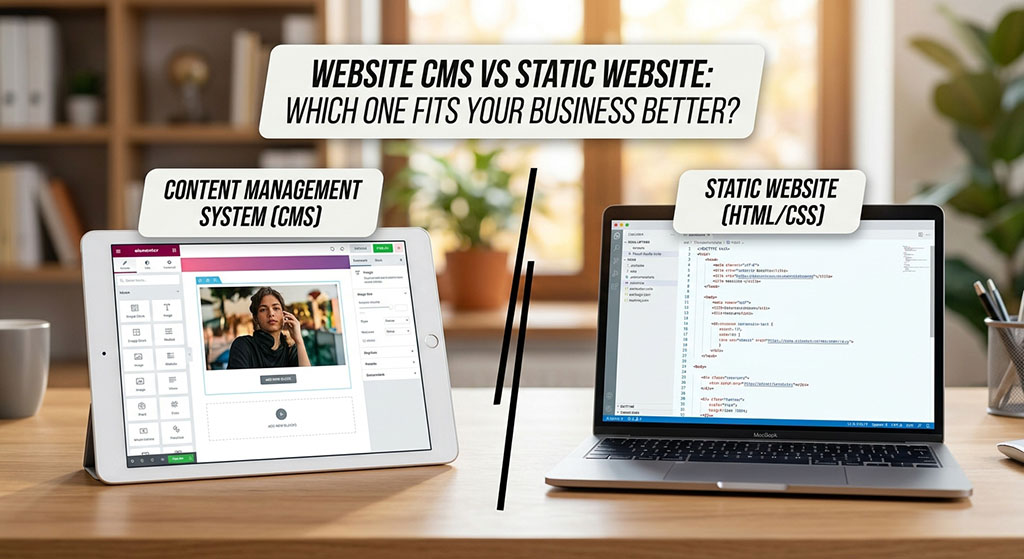
Static websites behave very similarly. A static website is usually built using HTML, CSS, Javascript where each page exists individually.
This approach creates websites that are lightweight, fast and highly controlled because fewer systems run behind the scenes.
Years ago, static websites were extremely common because businesses mainly needed company profiles, contact pages and simple information sites.
Static Websites Excel In Specific Situations
One mistake many people make today is assuming:
CMS websites are always better.
Actually, static websites remain excellent for:
- campaign microsites
- landing pages
- highly secure environments
- lightweight portfolio sites
- temporary promotional pages
because they are simple and efficient. Fewer moving parts usually means lower server load, fewer plugins, cleaner perfor,ance.
A static landing page for a product launch, an event registration and a short-term campaign can perform extremely well.
This is why many developers still love static websites for highly focused projects.
The problem begins when businesses expect static websites to behave like:
scalable marketing platforms
That is where limitations slowly appear.
CMS Websites Behave More Like Business Operating Systems
A CMS website works differently.
CMS stands for:
Content Management System
Platforms like WordPress, Drupal and Joomla allow businesses to manage website content dynamically through admin dashboards instead of editing code manually.
The easiest analogy?
A CMS behaves more like:
Google Docs for websites.
Instead of rebuilding pages manually, businesses can update articles, add products, publish blogs, edit images and create landing pages without touching technical code directly.
This flexibility became extremely important because modern websites today are no longer static brochures.
They evolved into:
- SEO platforms
- content marketing systems
- lead generation tools
- customer education hubs
And businesses increasingly need websites that can evolve continuously.
Why WordPress Became The Dominant Business Website Platform
According to W3Techs WordPress Statistics, WordPress powers a very large percentage of websites globally.
That dominance did not happen because businesses enjoy complexity.
It happened because modern businesses increasingly require content flexibility, SEO growth, integrations, scalability and easier management.
And WordPress solved many of these operational problems affordably.
A modern business website today may eventually need blog articles, landing pages, automation forms, CRM integrations, multilingual support, e-commerce functionality and SEO optimization.
Trying to build all these repeatedly using static coding eventually becomes difficult and expensive operationally.
This is why CMS platforms became business-friendly long-term.
The Real Difference Quietly Appears During Website Growth
Initially, static and CMS websites may look identical visually. A manufacturing company in Shah Alam may only need a homepage, About Us page, contact details, and service descriptions in the beginning, making a static website a practical and cost-effective choice.
At this stage, both website types can deliver a similar appearance and basic online presence.
However, after two or three years, the differences become much more obvious as the business grows and marketing needs evolve.
Once the company starts improving SEO, publishing technical articles, adding product catalogs, creating landing pages, and tracking marketing campaigns, the website needs continuous updates and expansion.
This is where CMS platforms become significantly more practical, because modern digital marketing depends heavily on content updates, SEO growth, campaign management, and data tracking not just having a “website online.”
Need Help With Your Website?
Your website should support your business, not create more technical problems.
From website design and maintenance, security to SEO, performance, and long-term support,
Skytomato helps Malaysian businesses manage and grow their websites with confidence.
Get in touch with us today!
SEO Changed Website Strategy Completely
Years ago, websites mainly existed to provide information.
Today, websites increasingly exist to:
- attract search traffic
- educate customers
- answer search intent
- build topical authority
SEO today requires more than just having a website online. It involves frequent content publishing, structured internal linking, metadata management, and overall content scalability. These elements need to work together consistently for a website to perform well in search engines.
CMS systems handle these requirements much more naturally because they are built for ongoing content updates and structured content management. With a CMS, managing SEO-related tasks becomes more efficient and less dependent on technical manual editing.
A static website can still rank on Google effectively, especially for smaller sites with limited pages and low update frequency. However, it works best when the content remains relatively fixed over time.
Once a business needs to scale such as producing dozens of articles, building FAQ structures, creating SEO landing pages, and publishing content regularly manual static website management becomes increasingly inefficient and time-consuming.
This is one of the key reasons why modern digital marketing agencies tend to prefer CMS platforms for long-term SEO and growth-focused projects.
Static Websites Usually Win In Raw Speed
To be fair:
static websites are usually faster.
Because they contain fewer database calls, less backend processing and minimal plugins. This allows pages to load extremely quickly.
And speed matters.
According to Google Think With Google, mobile users increasingly abandon slow websites quickly.
This is why static websites often feel snappy, lightweight and instant, especially on slower mobile connections.
But modern CMS websites can also achieve excellent speed today through:
- caching systems
- optimized hosting
- CDNs
- image optimization
- performance tuning
This is why experienced web management today focuses heavily on ongoing optimization instead of assuming CMS automatically means slow performance.
Security Discussions Around CMS Are Often Misunderstood
One common misconception:
WordPress is insecure.
Actually, WordPress itself is not the problem, poor maintenance usually is.
CMS websites typically contain plugins, themes, and integrations, all of which require regular updates, patching, and ongoing security monitoring. Without proper maintenance, vulnerabilities can gradually appear over time, especially when outdated components are left unattended.
On the other hand, static websites naturally expose fewer attack surfaces because they contain fewer moving backend systems.
This is why static websites are often preferred for highly controlled enterprise environments, lightweight campaign sites, and simple informational pages where stability and minimal maintenance are priorities.
However, CMS websites are still highly secure when they are properly managed. With the right practices such as firewalls, regular updates, reliable backups, strict access controls, and continuous monitoring systems, they can operate safely and effectively even at scale.
Modern website security today is less about:
“Which platform is perfect?”
and more about:
“How professionally is the website maintained?”
Maintenance Quietly Became The Bigger Conversation
This is where many businesses experience the biggest mindset shift.
Years ago, websites were treated like “one-time design projects”.
Today, websites behave more like software systems, digital business infrastructure and operational platforms which require updates, optimization, monitoring, backup and performance management continuously.
CMS websites especially benefit from structured maintenance, plugin management, security reviews and uptime monitoring because they evolve constantly.
This is why modern businesses increasingly require website management
instead of only website design.
AI Search Quietly Favors Structured Content Systems
One newer shift many businesses still underestimate:
AI systems increasingly analyze website structure deeply.
Search engines today no longer look at websites as just collections of pages. They now evaluate deeper signals such as topical authority, FAQ structures, expertise indicators, content consistency, and how well information is semantically organized.
CMS systems generally support these requirements more naturally because they are built for scalable publishing and structured organization.
This is why websites today increasingly support SEO, AEO (Answer Engine Optimization) and GEO (Generative Engine Optimization) instead of simply existing online.
So Which One Should Businesses Choose?
Honestly?
There is no universal answer.
A static website may work perfectly for lightweight campaigns, simple landing pages and tightly controlled informational sites.
A CMS website usually works better for growing businesses, SEO-driven strategies, content marketing and scalable digital ecosystems.
The smarter question is not:
“Which one is technically better?”
The better question is:
“What kind of business growth do we expect over the next few years?”
Because websites today are no longer static brochures. They became living digital systems and the businesses growing strongest online are usually the ones choosing website architecture aligned with marketing strategy, scalability and long-term operational needs instead of purely initial convenience.
Simple Comparison Table
| Static Website | CMS Website |
|---|---|
| Extremely fast performance | Flexible content management |
| Lower complexity | Easier SEO scaling |
| Fewer security attack surfaces | Easier marketing integration |
| Harder to update frequently | Easier for non-technical teams |
| Best for simple websites | Best for growing businesses |
| Limited content scalability | Better for blogs and SEO |
The Website System You Choose Quietly Shapes Your Future Growth
What is a static website?
A static website uses fixed pages coded manually with limited dynamic functionality.
What is a CMS website?
A CMS website allows businesses to manage content through admin dashboards without coding manually.
Is WordPress good for business websites?
Yes. WordPress supports SEO, scalability, content marketing, and easier long-term management.
Are static websites faster than CMS websites?
Generally yes, because static websites contain fewer backend processes and plugins.
Which is better for SEO: static or CMS?
CMS platforms are usually better for long-term SEO scalability and content publishing.
Are CMS websites harder to maintain?
CMS websites require updates and security management, but offer much greater flexibility and scalability.
Need Help Choosing The Right Website System For Long-Term Growth?
From website architecture and CMS planning to SEO, security, hosting, analytics, and long-term web management, Skytomato helps Malaysian businesses build websites designed for sustainable growth.
Talk To Our Web Management Team